

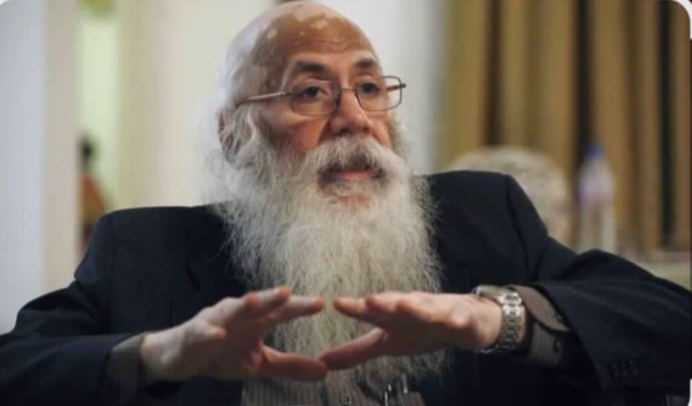
Interview of Prof. Arun Kumar (JNU) on “Current International Trade & Geopolitical Situation and Its Impact on Indian Business and Economy”
(Professor Arun Kumar is a renowned economist and the country's leading authority on Indian economy.)
Interviewer: Sir. First of all, thank you very much for giving us your valuable time. Sir, I would just like to give you a brief introduction. We are the Rifah Chamber of Commerce and Industry. We are working in around 18 states in India Businessmen from all over India are associated with us, especially those working and growing well in the MSME—Micro, Small, and Medium Enterprises—sector, sir.
Without taking up too much of your time, sir, let's start with the questions. Our theme is "Current International Trade and Geopolitical Situation and its Impact on Indian Business and Economy."
Okay, So, sir, how do you assess the current global trade environment, particularly in light of ongoing geopolitical tensions and shifting economic alliances?
Prof. Arun Kumar: Yes, yes. So, the current situation is that a problem has emerged in West Asia, where a war is ongoing. Before that, a war was going on in Ukraine, a war was going on in Palestine, and if you look closely, conflicts are happening in several places across Africa as well.
It is my belief that following the Ukraine war, a new Cold War has commenced. On one side, you have the wealthy Western countries, and on the other side, there are Russia, China, Iran, and North Korea. This new Cold War that has emerged is essentially between two capitalist blocks. This is fundamentally a war over resources.
Now, for instance, the United States is attacking Iran primarily to seize control of Iran's crude oil reserves. Before this, it intervened in Venezuela, where it targeted the president, removed him, and took him out of the country. The new president appointed there now listens to the U.S. Thus, the U.S. already has massive reserves of its own, but it seeks further control. Venezuela holds the largest oil reserves, and the U.S. controls them. Apart from that, leaving Iran aside, the U.S. has defense pacts and treaties with other nations in West Asia, giving it leverage there as well.
So, I believe that the U.S. is attacking Iran to establish control over nearly 80% of the world's oil reserves. Meanwhile, Israel has a different objective. It wants to weaken Iran to such an extent that it never poses a threat in the future. This is why this war is continuing, as the U.S., Israel, and Iran all have entirely different targets. Iran is fighting to protect its sovereignty, Israel wants to eliminate Iran as a threat, and the U.S. wants control over Iran. All three have different agendas, which is why no agreement has been reached yet. Although a ceasefire took place two months ago, conflict keeps flaring up intermittently.
I believe this situation is highly fragile for the world. This is because the Gulf region accounts for 20% of the world's crude oil and gas supply. Furthermore, 30% of the energy consumed globally is derived from this oil and gas. This implies that if a shortage of 20% occurs within that 30% sector, it results in an overall global energy shortage of 6%. Now, you can manage a 1%, 2%, or 3% deficit somehow, but a 3% to 4% energy shortage will inevitably persist globally.
When there is an energy shortage, it directly impacts production, consumption, and distribution, because nothing can function without energy. If you want to manufacture any product, you need energy; for consumption or transportation, you need energy. When an energy shortage occurs, two things happen: first, energy prices rise. Crude oil prices had already surged by 50% before this war even began. Consequently, prices of all commodities increase since energy is utilized in everything.
Second, when there is a shortage, production drops. This is because numerous secondary products are derived from crude oil, such as sulfur, helium, and various chemicals. These chemicals are used to manufacture medicines, plastics, packaging materials, and fertilizers. Therefore, a shortage of crude oil translates into a shortage of all these essential items.
This, in turn, impacts food production and agriculture. It affects our packaging industry, which disrupts the distribution of all goods, and impacts transportation as well. It heavily affects consumers. For example, in India, a shortage of gas led to black-marketing, which severely affected the poor. They didn't have gas available to cook food at home. Even if they ate at roadside eateries (dhabas), they faced a 50% increase in food prices. A cup of tea that used to cost ₹10 went up to ₹15 or ₹20. Similarly, a food platter (thali) that used to cost ₹80 shot up to ₹120.
Thus, the common man is facing hardships from all sides. A regular low-income worker earns around ₹10,000 to ₹12,000, as people mentioned during protests in Noida. Now, if a person earning ₹10,000–₹12,000 finds that a gas cylinder originally priced at ₹950 has soared to ₹4,000, they face an additional burden of ₹3,000. Out of their small earnings, ₹3,000 is gone just for gas. For them, the inflation rate isn't just 3.5% or 4%; it effectively becomes a 30% inflation rate. If you add other factors like expensive food and daily items, they are experiencing nearly 40% inflation. Their condition has become miserable.
This is why you see farmers and laborers protesting in places like Gurgaon, Ghaziabad, Noida, Punjab, Haryana, Rajasthan, and Surat. Many have even started migrating back to their villages from cities, much like what happened during the pandemic. This migration is happening because employment opportunities shrank in sectors dependent on gas due to its shortage.
Furthermore, transportation has seen a decline, which implies that the distribution of goods has weakened. This gives rise to further black-marketing. For instance, a deficit in fertilizer supply led to its black-marketing. Shopkeepers even started coercing farmers, stating they wouldn't sell them fertilizer unless they bought other items like micronutrients alongside it.
Therefore, I believe this situation is creating a massive upheaval globally. Not only is there an energy shortage, but global alliances are also shifting significantly. For example, Iran, with China's assistance, carried out precision bombings, destroying several U.S. bases in West Asia. They launched attacks on Israel as well, striking multiple locations despite the presence of the Iron Dome.
So, to summarize, a new Cold War has definitely begun. This will inevitably impact global trade and financial markets. Additionally, supply chains, which had grown exceedingly long, will now shorten. The U.S. has already indicated that it wants to bring its capital back home. As Donald Trump stated long ago, "Why are iPhones manufactured in India and China? They should be made in America." Similarly, regarding semiconductor chip production, the Biden administration has consistently pushed for manufacturing to take place within the U.S. Currently, it happens in Taiwan and South Korea, but they want it in the U.S. to mitigate risks associated with China's threat over Taiwan.
All of this means that international trade and financial movements will be heavily impacted. We also witnessed how the U.S. froze Russian assets after the Ukraine war. This sent a clear message to all countries that their assets could be frozen at any time, or they could be excluded from the SWIFT banking framework. Consequently, there is an ongoing movement to diminish the dominance of the U.S. dollar. A shift toward dedollarization is underway. The BRICS nations have been attempting this, which is why Trump immediately stated upon taking office that if BRICS moves toward dedollarization, a 500% tariff will be imposed on them.
The U.S. derives immense economic benefits from the global dominance of the dollar. Its massive budget deficit and trade deficit are only sustainable because countries worldwide hold the dollar as a reserve currency. If people stop holding the dollar tomorrow, the U.S. will lose these advantages, and its standard of living will fall. Currently, its standard of living remains high because global trade allows cheap goods to flow into the country without negatively impacting its economy. It runs an exceptionally high budget deficit without facing immediate consequences. No other country could sustain such trade and budget deficits because no other currency is held globally the way the dollar is. Therefore, dedollarization will have a severe impact on the American economy.
Similarly, the World Trade Organization (WTO) has effectively been weakened by Trump. He bypassed WTO guidelines to directly impose tariffs. This marks a shift toward bilateral negotiations rather than multilateral trade. The system of multilateral agreements under the WTO, which operated on a model of mutual give-and-take, is eroding. Trump is choosing to negotiate unilaterally with nations. Even with close allies like Canada, Japan, South Korea, and the European Union, the U.S. has demanded one-sided concessions, asking them to eliminate tariffs on American goods while the U.S. retains a 15% tariff on theirs. Furthermore, he has demanded heavy investments, pressuring the EU for $600 billion and Japan for $550 billion in investments.
The U.S. is seeking aggressive concessions from close allies and is demanding similar terms from India, pushing for high tariffs on our end while expecting zero tariffs on theirs. These ongoing tariff disputes are affecting global trade and currency markets. As a result, central banks around the world have been shifting toward purchasing gold over the last two years. This has triggered a speculative surge in gold prices.
Central banks are acquiring gold to reduce their U.S. dollar holdings, and the Reserve Bank of India is doing the same. China initiated this shift a decade ago because it anticipated that the U.S. would eventually attempt to restrict and check its growth. We saw this during Trump’s first term when these tensions began, and the Biden administration continued it by restricting U.S. software and high-tech exports to prevent China from advancing further. However, China is a highly strategic thinker; it anticipated these hurdles and had already reduced its trade dependency on the U.S. while developing its own domestic semiconductor chips.
Previously, the U.S. had banned Huawei's 5G equipment, alleging that it contained spying software. Following this, it persuaded nations like Great Britain and India to bar Huawei from their networks as well. All of these factors combined are shaping the current global landscape.
and it was alleged that it contained spying software, or something similar. So, according to what they said, they told Britain, India, and everyone else not to install Huawei. However, Huawei developed its own chip on its own. So, I mean, China is a great strategic thinker; it anticipates these things beforehand and remains vigilant against them, forming a strategy on how to deal with it.
India has not done this. We haven't done the strategic planning that we should have, which is why we end up getting squeezed from three sides. We get squeezed by China, by Russia, and by America.
We have a $102 billion trade deficit with China. This means that we are essentially giving $102 billion in assistance to a nation that has entered our territory. The reason for this is that our technology is very weak. And the reason for *that* is our investment in technology and R&D is just 0.65% of our GDP, whereas China’s is 3%. Furthermore, their economy is five times larger than ours, meaning they spend 22 times more than us on R&D.
This is why they have become the world's manufacturing hub. They have started dominating all manufacturing areas. In the 1990s, they first dominated the toy market. Slowly, they moved into APIs (Active Pharmaceutical Ingredients)—for instance, in 2003–04, we were 90% self-sufficient in APIs. Today, we are having to import 90% of them. So, our self-sufficiency in pharmaceuticals has weakened.
Similarly, if you look at other things like electronic components, automobile components, and the machinery installed in factories—all of these have come from China. So, on one hand, we buy kite strings (manjha), Diwali lights, Ganesha idols, and water guns (pichkari) for Holi from them, but we also take high-technology items from China. So, we are suppressed by China, and as for Russia, some of our advanced weapons—like the S-400 missile, the BrahMos missile, and our Sukhoi aircraft—are Russian, so we cannot leave Russia's side either.
We have also been taking defense equipment from America for the past 15 years, like the C-17, helicopters, and howitzers. So, we get suppressed by America over there as well. We have tried to build a strategic partnership with America since 2005 when the nuclear issue came up. Because of that step, the government thought we would get better terms, but instead of giving us better terms, Donald Trump suppressed us even further.
So, we are unable to stand our ground on this. China, on the other hand, stands up against America. If America imposed tariffs, China retaliated by imposing tariffs as well. We didn't show that courage. In the last budget of 2025, we had already given a lot of concessions, and then we gave more concessions in this year's budget to America. We said we would buy more energy from you, we would buy defense equipment from you, and we would do more. Yet, America keeps suppressing us. They say we have to import $500 billion from them and that our trade needs to be balanced, and so on. So, we remain silent. We are unable to speak up.
Consequently, our strategic autonomy has, in a way, come to an end, and we have to listen to everyone instead of doing what is in our own interest—the way China speaks for its own interest and stands up. We are unable to do that. So, this massive upheaval taking place in the world over the last four to five years is having a fairly negative impact on us.
And that is why our rate of growth—despite what the government claims to be 6.5%—is actually only around 2% to 2.5%. This is because our unorganized sector is taking a beating. It has been badly hurt. First came the impact of demonetization, then the impact of a flawed GST, then the next year saw the NBFC (Non-Banking Financial Companies) crisis which affected it, and then the sudden lockdown in 2020 during the pandemic. So, our unorganized sector has suffered four or five consecutive shocks.
Therefore, I believe the unorganized sector is in decline. A common person will obviously do whatever it takes because they are poor; it’s not like they will sit idle without working. Whether they pull a rickshaw, pull a cart, carry loads on their head, sell tea by the roadside, sell vegetables, fruits, or roasted chickpeas—they have to engage in such work. So, we count that as them having found employment, whereas this employment is actually a sign of desperation rather than a means to increase their income.
We have a massive unemployment problem, and that is why the unorganized sector will do whatever it can out of desperation. Thus, the situation we have here is that the unorganized sector is declining, but the data we receive reflects the organized sector. We then assume that the unorganized sector is performing the same way as the organized sector. Our growth rate is 2% to 2.5%, and currently, our GDP is not $3.7 trillion—I believe it is around $2.5 trillion. This is because since the time of demonetization, there has been a decline of ₹10 to ₹12 lakh crore in our unorganized sector.
If there is a decline of ₹10 to ₹12 lakh crore every year, then over the 10 years since 2016, it amounts to a loss of about ₹110 to ₹120 lakh crore. What the government has given them in the form of freebies is barely ₹3 to ₹4 lakh crore a year. This means they have given ₹30 to ₹40 lakh crore, but the sector has suffered a loss of ₹120 lakh crore. In net terms, the unorganized sector is clearly declining, which is why our growth rate is weak.
Even our organized sector isn't investing much because demand is low. When our unorganized sector is declining and the organized sector is advancing, our inequality keeps rising. The more inequality increases, the more demand drops. Our organized sector also repeatedly states that they aren't investing more because demand is low; when demand increases, only then will they be able to invest more. The government keeps saying that they are investing heavily in the public sector, so the private sector should invest more too. To that, they respond that until our demand increases, public sector investment alone cannot drive our private investment forward.
Demand will only rise when money reaches the hands of the poor. In our country, inequality is rising rampantly. On one hand, the number of billionaires increases by 50 to 100 every year, while on the other hand, the poor keep getting crushed. Our figures aren't showing how bad the actual impact on our unorganized sector is.
There is just one metric: on our e-Shram portal, the Prime Minister stated in Parliament that around 30 crore people have registered. I heard it is now slightly over 31 crore. Now, those who are registering are the ones who are better off and have access to a computer. The extremely poor do not have computer access. So, these 31 crore people belong to the better-off segment of the unorganized sector. Those who are even poorer than them in the unorganized sector aren't even registered.
I believe data came out showing that out of these 30 crore people, 90% earn less than ₹10,000. This means they are below the poverty line or close to it. Since the World Bank's global poverty line is now $3 per person per day, a family of five needs an income of at least ₹32,000 to ₹33,000. Yet, here the income is just ₹10,000. Therefore, I believe the unorganized sector is hovering right around the poverty line.
When a person remains poor, where will their demand come from? It becomes difficult for the poor to even buy essentials with the money they have. They won't be able to buy gold, save money in any other way, or travel abroad.
So, with the recent price rise in gas cylinders and other things, when they had to spend an extra ₹3,000, they were left with no money to pay for their child's school fees or do anything else. Some are even cooking meals only once a day. Thus, they are facing all kinds of hardships because the inflation rate is actually 20% to 30%. Therefore, our inflation rate figure is wrong, and so is our production figure. This is because the data for the small units that have shut down does not come in; the data we receive is only from the organized sector. So, we are neither measuring production correctly nor inflation.
Because of this, I believe stagflation has arrived for our general public. Stagflation may not have arrived for the rich because there is growth in the organized sector, and the prices of regular goods there aren't rising as sharply as those of energy and food items, which directly impact the poor. So, stagflation has entered the economy in a way. Now, if this situation continues to deteriorate and our energy shortages persist, news is already emerging that transportation has decreased and production has dropped in several sectors. We will then slowly head toward a recession. If this war continues like this and the energy shortage persists, the troubles will keep mounting. Therefore, I believe there are many problems in our economy, and they are only going to increase further.
Interviewer: Okay, sir. Thank you so much, sir. You gave such an excellent answer that it covered several of our questions. So, sir, without taking up more time, let's move forward. Sir, we are currently seeing that many countries are choosing protectionist trade policies. In this context, what kind of policy measures should the Indian government adopt, and what should they prioritize to strengthen, make resilient, and increase the competitiveness of our economy, our businessmen, and especially our Micro, Small, and Medium Enterprises (MSMEs)? What should the government do at the foreign level as well as at the domestic level, sir?
Prof Arun Kumar: See, we must first separate the MSMEs; we should separate 'Micro' from 'Small' and 'Medium'.
Interviewer: Right, sir.
Prof Arun Kumar: The reason is that 'Micro' is very small, and it consists of around 7 crore units. 'Small' and 'Medium' together comprise about 6 lakh units. Among them, 'Medium' accounts for 50,000, and 'Small' accounts for about 5.5 lakh units. In the micro-segment, the average employment is just 1.7 people per unit. So, it is entirely different.
Whatever the government announces for MSMEs usually goes to the Medium enterprises; Small and Micro units do not get it because they are virtually outside the market. Their capacity to take loans is very weak, and technology development is impossible for them. If a micro-unit has an average of 1.7 people employed, will that person handle marketing, technology, or finance? They cannot do it. Therefore, we must do something separate for 'Micro' and handle 'Small' and 'Medium' differently. This is the very first point.
Second, our foreign trade is a small part of our economy. And Foreign Direct Investment (FDI) is an even smaller part. In net terms, FDI last year was just around $1 to $2 billion, which is very small. It was just 1% to 2% of our total investment.
So, we need to depend on our internal economy rather than the external economy. The external economy is going through a very difficult phase due to global changes. As you can see, everyone is saying, *"Bring your capital back home." China is also saying, "We will manufacture more and more domestically."Because of this, we tried to curb trade with China, but our trade deficit, which was $85 billion three years ago, has now reached $102 billion. Despite all our efforts, we are unable to reduce our trade deficit with them.
We need to focus on our unorganized sector. Consumption there is so low that if we increase income there, consumption will shoot up. The textiles, leather goods, or food items that we are currently exporting can be consumed by our own unorganized sector. If you put more income into their hands, they will consume more textiles, more leather goods, and more food items.
We don't need to depend so heavily on foreign markets. When everyone across the world is closing their markets and trying to bring their capital back via 'onshoring' so it stays and grows within their own borders, we won't be able to export much anyway.
So, if we look at it, our organized sector should export to the unorganized sector. And the government should support the unorganized sector.
Prof Arun Kumar: Despite our efforts, we aren't able to reduce our trade deficit with them. So, we should focus on our unorganized sector. There is such low consumption there that if we increase income there, consumption will rise. As for everything we are exporting—whether it’s textiles, leather goods, or food items—our unorganized sector will consume it. Right? So, if you put more income into their hands, they will consume more textiles, more leather goods, and more food products. Then, we won’t need to depend so much on external markets.
Moreover, when everyone in the world is closing their markets and trying to practice "onshoring" of capital so that all external capital returns home to boost their own growth, we won't be able to export as much under those conditions. Therefore, if we look at it, our organized sector should export to the unorganized sector. And the government should help the unorganized sector. So, whatever export loss we are facing externally can all be sold right here. It’s not as if our poor people have plenty of clothes, or plenty of shoes, or enough food. There is a huge shortage there; they are living in deep poverty. If more income gets into their hands, there will be an immediate boost.
The problem lies with our government's flawed policies. The flawed policy is that we are promoting the organized sector, thinking we will organize the unorganized sector. The unorganized sector cannot be organized. Take our farming: 85% of farmers own less than five acres of land. A vast number of farmers cultivate just half an acre, one acre, or two acres of land. How can they become organized? They simply cannot. You can convert them into laborers, meaning they will leave farming and become wage laborers, but they cannot be organized.
Similarly, our micro-sector employs 1.7 crore (17 million) people. That cannot be organized either. How can it handle technology, marketing, or finance on its own? So, we need to help it. Now, how do we help it? This is also very important. If you look at our agriculture, there is a massive amount of surplus labor, which we call disguised unemployment. We need to move labor out of there and bring it into the micro-sector. And for that, what kind of help does the micro-sector need? They need assistance with marketing, finance, and technology. If we can form cooperatives for them... for example, Khurja. If Khurja has pottery and such, we can set up a cooperative for them so that they can take loans, handle marketing, and develop technology collectively. Similarly, if Ichalkaranji has textiles, we can form a textile cooperative there to bring them together for marketing, finance, and technology. So, we should encourage these kinds of clusters in various places so they can work in a combined way.
The second point is that the government must promote employment-intensive—meaning labor-intensive—sectors. Right now, the government is only focusing on capital-intensive sectors. The central government's capital investment of 11.5 lakh crore rupees is mostly going into capital-intensive sectors—like mega roads, large trade corridors, the IT sector, and the power sector. These don't generate employment.
Previously, when a road was built, hundreds of people worked on it. Now, you see large bulldozers, JCBs, tractors, and cranes with barely ten people working. So, road construction, highways, and flyovers have all become capital-intensive; they don't offer much employment. Similarly, the railway freight corridor doesn't either. And the power and IT sectors generate very little employment. Even in agriculture, employment is disappearing because we are using tractors, harvester combines, threshers, and potato-digging machines. So, it's not there in agriculture either. Therefore, we must uplift our micro-sector. Special provisions must be made for it, and the micro-sector needs to be treated separately to achieve this.
Furthermore, the GST has had a very negative impact on the small and micro-sectors. I wrote back in 2015 that GST is not right for us. And in 1986, I wrote about why VAT is not suitable for our country, because small traders and small producers cannot cope with VAT. Implementing VAT and GST has dealt them a heavy blow. And that is why you see a shift in demand from the unorganized sector to the organized sector. There is clear evidence of this, whether in textiles, leather goods, pressure cookers, the luggage industry, or the trade sector. In trade, it is obvious: e-commerce is growing by 30%, while neighborhood stores are declining because all the demand is shifting there. The middle class, upper-middle class, and youth are ordering through e-commerce today instead of going to neighborhood stores. Neighborhood stores are labor-intensive, whereas e-commerce is highly capital-intensive and creates very little employment. So, this creates an unemployment problem. And as the unemployment problem grows, wages weaken. When wages weaken, it impacts everything.
The government ought to boost labor-intensive sectors like the rural employment guarantee scheme, education, healthcare, agricultural development, and rural development. But the government cuts budgets in these very areas while increasing spending on capital-intensive sectors. So, the government's policies themselves are flawed. Whether it is GST, promoting capital-intensive sectors, or budget priorities, they are all flawed because crony capitalism is running the country. Due to crony capitalism, they are helping their cronies, which means other capitalists are also taking a hit. This is why high-net-worth individuals are leaving the country. Between 2014 and 2019, 23,000 people moved abroad. In 2019, another 7,500 left. In 2022, another 7,500 left. The data for the intervening years isn't available, but if we look at this trend, out of 2.5 lakh ultra-high-net-worth individuals, 50,000 have left the country. This means the investment climate is not favorable. If the investment climate isn't good, there won't be investment, and growth will weaken.
Therefore, I believe the government must change its policies. If they don't, the hardships will only increase. So, by focusing on the real issues, the government's priority should be to generate employment, increase agricultural income, provide minimum support prices, and support the micro and small sectors, rather than focusing on capital-intensive and organized sectors. The government's policy of trying to turn the unorganized sector into an organized one is, in my view, the root cause of the mess.
Interviewer: Okay, thank you so much, sir. In this too, sir, you have covered so many things. This is your only... this is your legacy, sir, which we are able to access by contacting you. So, sir, we are now at the final stage. We would just like to know from you—as an economist and an international trade expert who looks at all these aspects—what advice would you like to give to entrepreneurs, business owners, and young professionals in this rapidly changing global economic landscape, especially in the context of the Indian economy that you just described? What would be your advice to entrepreneurs, business owners, and young professionals?
Prof Arun Kumar: Yes, but I believe that if our businessmen understand the reality... and if they realize that when the economy does well, they will do well too. If the economy doesn't do well, they won't do well either. If 94% of the people who are in the unorganized sector remain in distress, the economy can never do very well. It will always remain in an unstable situation. Any shock will cause a downturn. So, there should be a more equitable policy where inequality is minimized. They should support such a policy.
Direct taxes should be increased and indirect taxes should be reduced; this will also benefit our businesses because when demand increases, their production will rise. Right now, they think, "If I am paying 30% tax on my profit and tomorrow it becomes 40%, my income will drop, and what was 70 will become 60." But this is flawed thinking; it's micro-level thinking. If the government collects taxes and reduces indirect taxes, thereby generating more employment, their income will double from 100 to 200. Then, even with a 40% tax rate, they will pay 80 rupees and keep 120, whereas right now, out of 100, they are only keeping 70.
Therefore, paying more direct taxes—like wealth tax and income tax—is not going to harm them. Right now, they are acting like a frog in a well, operating with a narrow vision. Their vision is limited to, "Let me see what is in my hands today." They need to adopt a macro view and realize that the more direct taxes we pay, and the more the government uses that money to generate employment and lift the micro-sector, the more we will benefit.
In other words, benefiting the unorganized sector ultimately benefits the organized sector too. If you give 100 rupees to a poor man, he will spend the entire 100 rupees. He will buy slippers for himself, some clothes for his wife, a school bag for his child, or a utensil for the kitchen. But if you give 100 rupees to a rich man, he won't spend any of it here; at most, he will take a trip to Mauritius. If he goes to Mauritius, he will spend the money there, not here. So, that is not going to increase our domestic demand.
Therefore, our demand will only increase when the hands of the 85% small and medium farmers, and the 11.5 crore (115 million) people in the micro-sector, get more income. So, I believe our business community and professionals, who are currently evading black money on a massive scale, need to stop generating black money. They should start paying their taxes honestly. By paying taxes and pressing for the upliftment of our unorganized sector, the organized sector will also grow rapidly. The business of our businessmen will grow, and our professionals will get more work. When prosperity comes to the country, professionals will get more work—whether it is a chartered accountant, as businesses grow, the work for chartered accountants will increase. Other sectors like education and healthcare will also pick up pace when the government spends more on them. So, all professional classes and the organized sector will benefit. Therefore, supporting progressive policies has become crucial.
Currently, we are following very regressive policies. We are depending on indirect taxes instead of direct taxes. Indirect taxes make up 11.5% of our GDP, while direct taxes are only about 6%. We aren't relying on direct taxes, but on indirect taxes, and indirect taxes are inflationary, whereas direct taxes are not. When inflation rises, it breaks the back of the poor man even further, and he reduces his consumption even more. So, we have to think at a macro level. If we think at a macro level, we will pay our taxes correctly, we won't fuel the black money economy, and we won't resist wealth tax.
But the ultra-rich resist wealth tax. They are the ones who say wealth tax shouldn't be levied, and they engage in generating black money in every possible way. They pull money out of the country through hawala and the black economy. All these wrong practices negatively impact the country. This negativity exists within our affluent society—among our professional and business classes. Their thinking is very negative. They think, "Let me evade taxes, pay less, and fill my own pockets." But this damages the nation. Therefore, a national spirit is very much needed.
Interviewer: Okay, sir. Thank you so much, sir. Sir, just one final question for you. What would be your advice, suggestion, and vision for the Indian economy over the next five years, and for its success in the global market?
Prof Arun Kumar: My view is simply that we must focus on our own country rather than looking outwards. Not much is going to happen externally anymore because four major threats are visible right now. One is the ongoing wars, because of which our exports cannot grow much. Second is the growing environmental crisis, which is going to severely impact our food production and other output. So, we must pay attention to that. Third, the arrival of Artificial Intelligence is going to deal a massive blow to employment.
So, these three or four massive shocks—along with the global Cold War that I mentioned—are going to have a huge impact. We need to stabilize our own economy first. If we manage our economy well, we can handle the threats coming from outside. If we don't manage our economy, we won't be able to protect ourselves from external threats either. Therefore, our topmost priority must be to ensure our economy runs smoothly and that inequality is reduced so that our market expands. Then, we can perform much better.
Interviewer: Thank you so much, sir, for your valuable time, and for covering everything in such detail with such strong arguments. Sir, this interview will soon be published in our magazine, both online and offline. We will certainly deliver a hard copy to you, and it will be distributed across all our networks, pan-India and globally. Thank you so much, sir. Thank you.